Humanity Accidentally Created More Work
Every company has work nobody should be doing anymore. Copying data between systems. Updating spreadsheets. Pulling the same report every Friday. Rewriting meeting notes nobody wanted in the first place. Acting as the human bridge between five disconnected tools that all promised to “streamline operations.” Humanity invented artificial intelligence and somehow ended up with more tabs open than ever.
The promise of AI was supposed to be simple: eliminate repetitive work so humans could focus on creativity, strategy, and decision-making. Instead, most companies accidentally created a new category of labor: managing AI tools.
Workers now spend huge portions of their day toggling between applications, reorienting themselves after interruptions, and rebuilding context over and over again. According to Harvard Business Review, employees toggle between apps nearly 1,200 times per day, consuming massive amounts of time and mental energy.
The problem is no longer intelligence. The problem is execution.
Most “AI Automation” Is Still Manual Labor
Prompting a chatbot is not automation. Copying an AI response into another system is not automation. Reviewing every single output before manually triggering the next step is not automation. That’s just work with extra steps.
Most AI tools today stop at conversation. They generate drafts, suggestions, summaries, and recommendations, but humans still sit in the middle stitching everything together manually. The result? More operational overhead disguised as innovation.
Research from the University of California, Irvine found that constant interruptions and task switching increase stress, reduce productivity, and create measurable cognitive fatigue.
Modern work has quietly become a cycle of:
reopening tabs
rebuilding context
checking dashboards
moving information manually
supervising software that was supposed to help
We didn’t automate work. We fragmented it.
Deterministic Systems Beat “Creative Guessing”
Businesses do not need more AI that talks. They need AI that executes. That distinction matters.
Most AI systems today are probabilistic. They generate responses dynamically based on patterns and probabilities. That works great for brainstorming or creative assistance. It works terribly when businesses need repeatable operational outcomes.
Nobody wants:
accounting workflows “trying a new approach”
approval systems improvising
compliance workflows hallucinating
operations pipelines behaving differently every Tuesday
In production environments, reliability matters more than novelty. Deterministic systems matter because they produce defined actions and repeatable outcomes. Same workflow. Same logic. Same execution path. Predictability becomes a superpower.
That is the bottleneck AI should eliminate.
Enter RivalBot: From Prompt to Production
This is where Rival.io and RivalBot come in.
We woke up and chose deterministic violence.
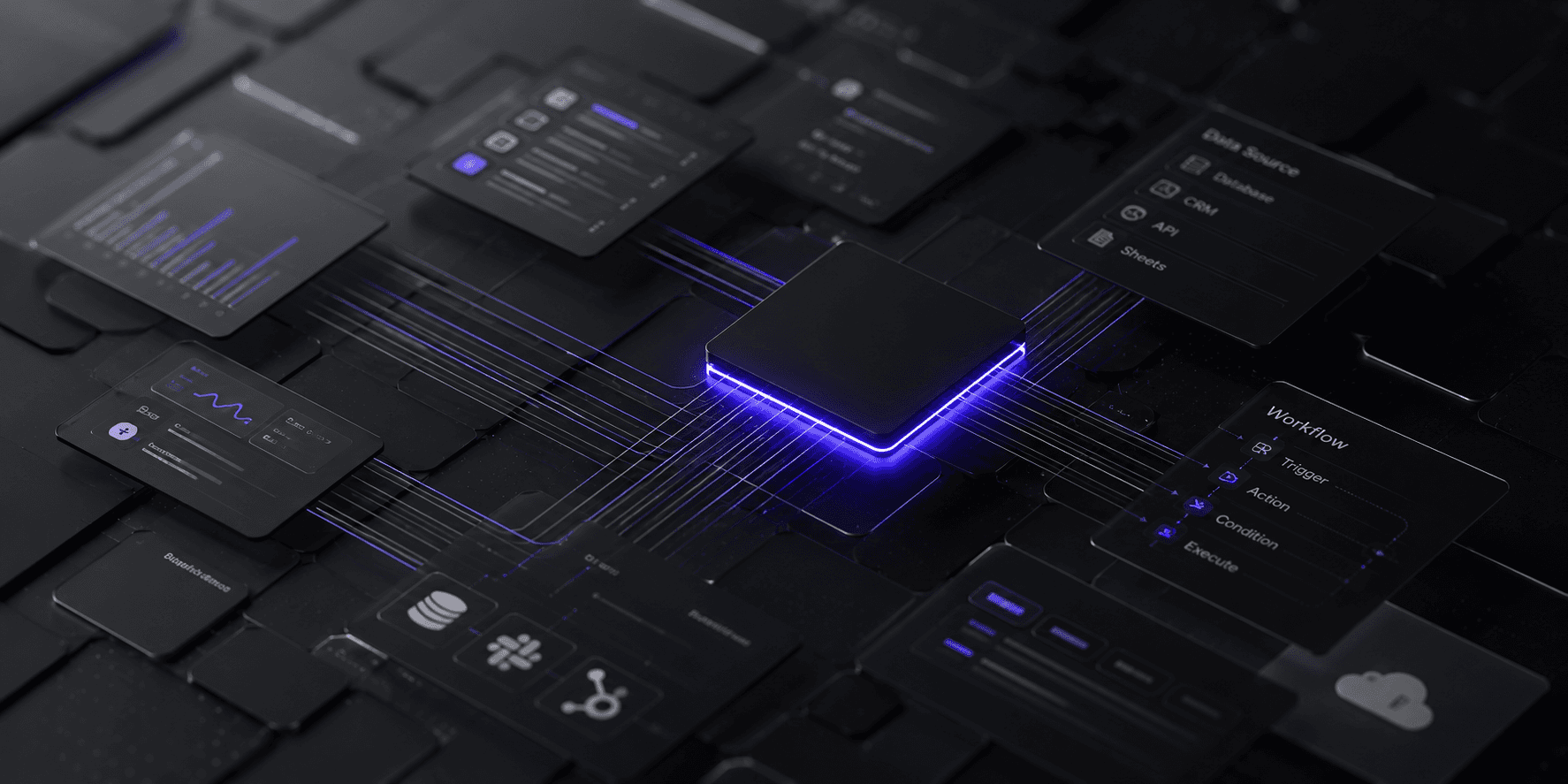
RivalBot was built around a simple idea: AI should execute work, not create more of it. Not more prompts. Not more tabs. Not another AI copilot asking humans to supervise every step like an exhausted middle manager. Execution. Instead of generating another wall of text for humans to deal with, RivalBot turns a single prompt into an executable workflow.
Send the email.
Query the database.
Route the approval.
Pull the report.
Update the CRM.
Trigger the workflow.
Execution over conversation.
Under the hood, RivalBot assembles reusable functions into deterministic workflows that run repeatedly and predictably. Same inputs. Same logic. Same execution path. Because businesses do not need AI that “gets creative” with operational systems. They need infrastructure that works. Rather than rebuilding the same automations from scratch inside every organization, workflows are composed from reusable marketplace functions designed to actually perform actions.
No infrastructure management. No rebuilding the same systems endlessly. No humans manually acting as APIs between disconnected software.
RivalBot doesn’t just answer questions. It runs the work.
The Best AI Is Invisible
The best automation eventually disappears. Not because it failed. Because it worked so well, nobody thinks about it anymore.
Great operational systems quietly remove friction in the background while humans focus on the things humans are actually good at:
creativity
judgment
relationships
leadership
strategy
Microsoft’s latest Work Trend Index points toward the same shift: humans increasingly oversee judgment and decision-making while AI handles execution-oriented tasks. That is the real future of work. Not humans working faster. Humans touch repetitive operational work less and less until entire categories of busywork disappear completely.
Repetitive Work Is an Economic Failure
Every duplicated workflow is wasted intelligence. Every company rebuilding the same automation internally is operational debt. Every employee manually moving information between disconnected tools is a systems failure.
Meanwhile, enterprises continue spending billions rebuilding repetitive infrastructure while AI costs spiral upward across bloated software stacks. The problem isn’t a lack of intelligence anymore. The problem is fragmented execution.
That’s why the future of AI belongs to systems that:
execute reliably
compose reusable workflows
route intelligently
reduce operational drag
compound efficiency over time
The companies that win will not be the ones with the most chatbots. They’ll be the ones that eliminate the most unnecessary work.
God Save the Humans
Humans are good at:
ideas
creativity
judgment
leadership
relationships
Humans are terrible at repetitive operational loops.
We should not spend our lives:
updating CRMs
chasing approvals
moving data manually
rebuilding the same workflows every quarter
acting as middleware between disconnected systems
The bots can have the repetitive work. Humans have better things to do. Plus, we’ve suffered enough. God save the humans.