
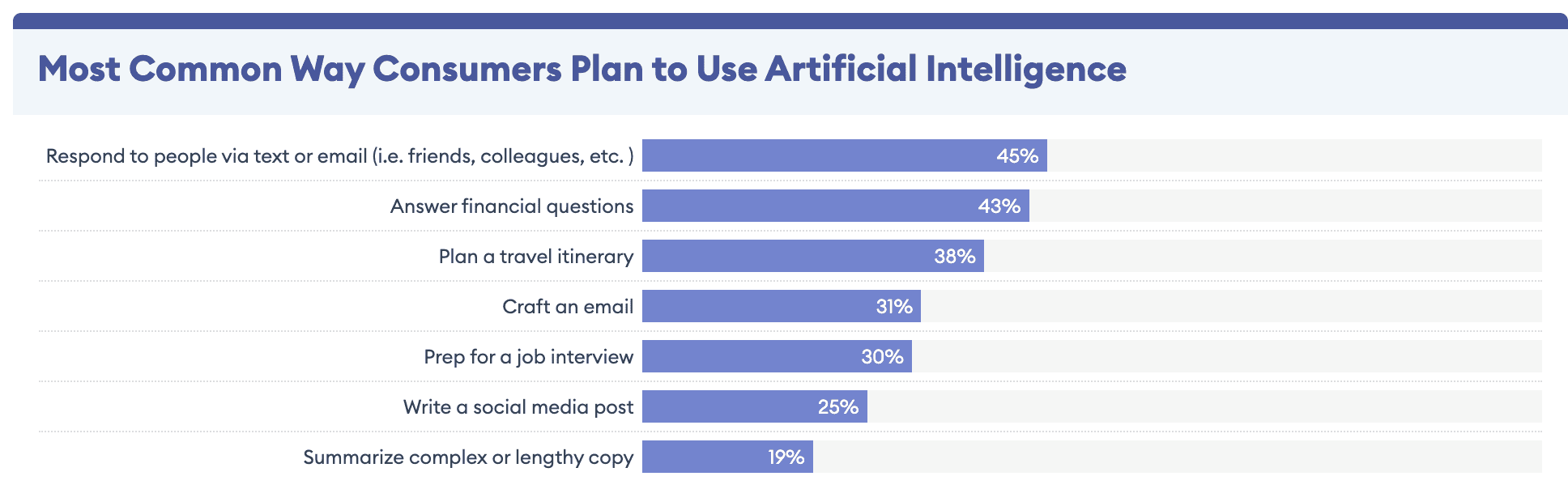
Source: Forbes Advisor AI Usage Survey
Forbes recently published a chart showing the most common ways consumers plan to use artificial intelligence.
The top use cases?
responding to email
answering financial questions
planning trips
writing social posts
interview prep
summarizing content
Useful? Absolutely.
But also: deeply boring.
Humanity unlocked generative AI and immediately used it to avoid typing emails.
Meanwhile, the real AI opportunity is sitting almost completely untouched:
operational workflows
approvals
reporting systems
cross-functional coordination
organizational memory
workflow orchestration
The market is still obsessed with AI helping humans work slightly faster. But the companies that win the next decade will use AI to remove routine work entirely.
That shift changes everything.
AI Is Still Being Used Like a Productivity Accessory
Right now, most AI adoption looks like this:
“help me draft this”
“summarize this PDF”
“rewrite this email”
“make this sound better”
“turn this into bullet points”
Which is fine. But it’s not transformation. It’s productivity assistance.
That’s not operational AI. That’s AI-flavored busywork.
The Most Valuable AI Use Cases Aren’t Trendy
Nobody goes viral talking about:
approval routing
workflow orchestration
AI governance
reporting automation
operational coordination
organizational memory systems
But those are the systems that actually move businesses forward.
The next phase of AI is not: “Help me write this faster.”
It’s: “Why is a human manually coordinating this process at all?”
That’s where AI becomes a force multiplier instead of a novelty.
The Untapped AI Layer: Operational Execution
The most valuable AI use cases are happening beneath the surface. Not flashy chatbot demos. Operational systems.
Here’s where AI becomes transformational instead of performative:
AI-Powered Operational Reporting: Instead of manually pulling data every week, AI assembles, analyzes, formats, and distributes reporting automatically.
Workflow Orchestration: AI coordinates approvals, escalations, requests, and actions between departments without humans acting as middlemen.
Organizational Memory: AI remembers workflows, decisions, systems, and context instead of letting operational knowledge disappear every quarter.
Cross-System Execution: AI connects CRMs, databases, internal tools, messaging systems, and workflows together instead of operating inside isolated chat windows.
Reusable Operational Infrastructure: Instead of rebuilding workflows repeatedly, organizations deploy reusable systems that scale across teams.
Invisible work with massive impact. That’s the real enterprise AI opportunity. Not another AI-generated LinkedIn caption.
AI Use Cases That Are Actually Interesting
Here’s where AI becomes transformational instead of performative:
AI-Powered Operational Reporting: Instead of manually pulling data every week, AI assembles, analyzes, formats, and distributes reporting automatically.
Workflow Orchestration: AI coordinates approvals, escalations, requests, and actions between departments without humans acting as middlemen.
Organizational Memory: AI remembers workflows, decisions, systems, and context instead of letting operational knowledge disappear every quarter.
Cross-System Execution: AI connects CRMs, databases, internal tools, messaging systems, and workflows together instead of operating inside isolated chat windows.
Reusable Operational Infrastructure: Instead of rebuilding workflows repeatedly, organizations deploy reusable systems that scale across teams.
That’s the real enterprise AI opportunity. Not another AI-generated LinkedIn caption.
The Future of AI Is Invisible
The most valuable technology eventually disappears into infrastructure.
Nobody talks about electricity anymore.
Nobody gets excited about databases.
Nobody writes think pieces about APIs.
Infrastructure becomes invisible once it becomes essential. That’s where AI is heading.
The companies that win the next phase of AI adoption will stop asking: “How can AI make employees slightly faster?”
And start asking: “What operational work should exist at all?”
Stop Building Productivity Theater
The Forbes list reflects where AI adoption starts. Enterprise value is where AI execution begins. The companies that dominate the next decade will not simply use AI to generate more content faster.
They’ll use AI to:
operationalize workflows
orchestrate systems
reduce operational drag
eliminate repetitive work
deploy reusable infrastructure
execute at scale
That’s the difference between AI experimentation and operational AI.
To start building operational AI workflows, or to deploy expert-built workflows that already exist, explore what on Rival Marketplace.