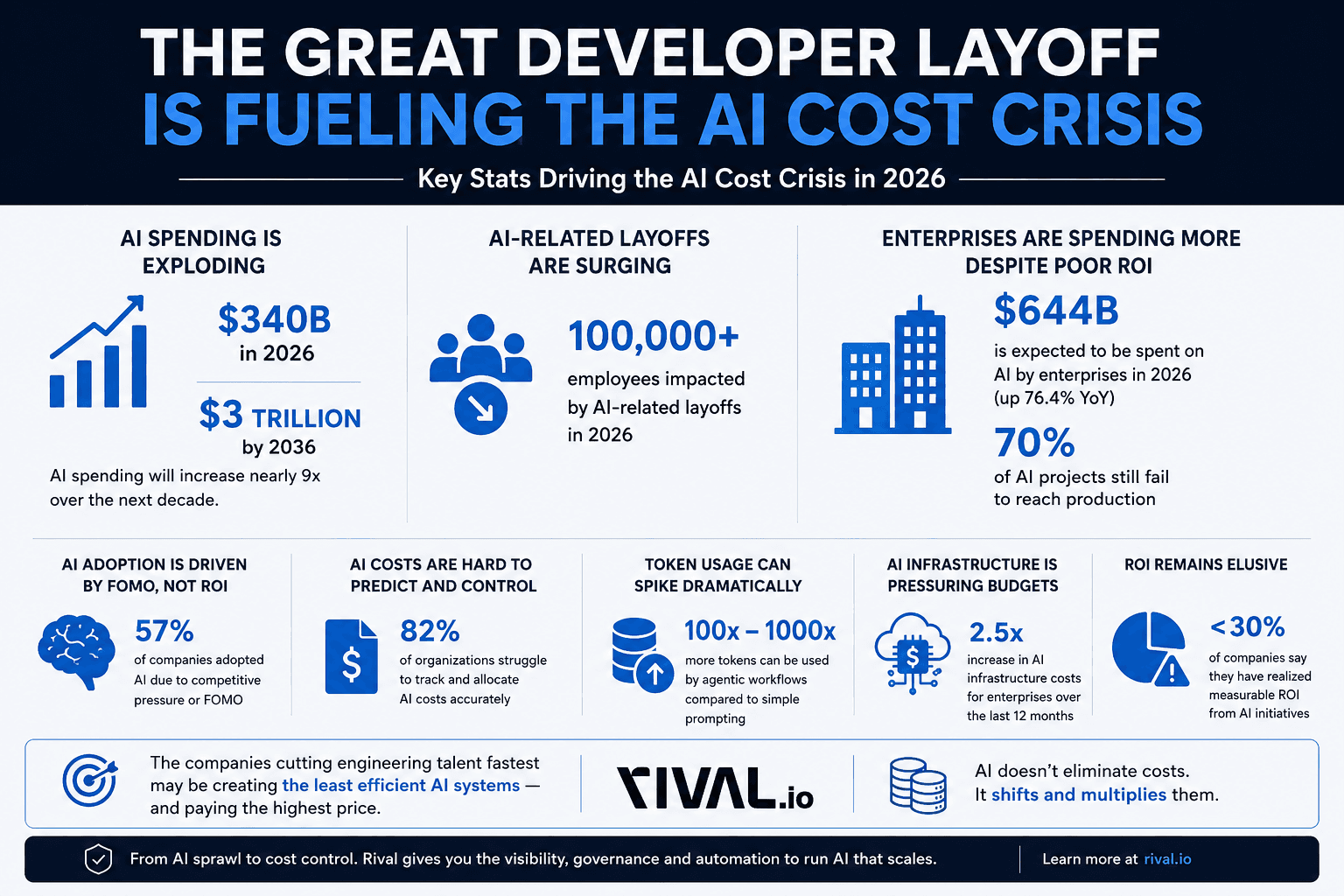
Something I keep seeing happen over and over again right now.
A company lays off developers because leadership believes AI will allow them to move faster with fewer people. They subscribe to a frontier model. Everyone starts building. The demos look great. Leadership celebrates. The AI initiative gets expanded.
Then the bill arrives. And nobody understands why it is so high. What is happening is not actually that surprising if you spend time close to these systems. There is a massive difference between getting AI to generate something and getting AI to operate efficiently inside a company. Those are two completely different problems.
The first problem is easy. The second problem is infrastructure.
Most organizations right now are operationalizing AI the same way people used to operationalize spreadsheets. One team starts using one model. Another department starts experimenting with another tool. Someone builds an internal chatbot. Someone else creates an agent workflow. Nobody has governance. Nobody has routing. Nobody knows which models are being used for which tasks. Nobody understands the operational cost structure until the invoice shows up.
It is data sprawl all over again, except now the spreadsheets are autonomous. The other thing I think the market is underestimating is how much senior technical oversight still matters.
The frontier coding models are incredibly powerful in the right hands. I use them every day. They can accelerate development dramatically. But they are not magic. They still require experienced developers who understand architecture, validation, performance, security, and operational design.
If you remove too much engineering experience from an organization, the AI does not suddenly become self-managing. What actually happens is the remaining senior developers become responsible for reviewing, correcting, restructuring, and operationalizing everything the system generates. And while they are doing that, the organization is burning tokens aggressively.
This becomes even worse when companies operationalize everything on the same expensive model they used during development.
That is one of the biggest mistakes I see right now.
The model you use to solve a hard reasoning problem should not necessarily be the same model you use for day-to-day operations. Some workflows require deep reasoning. Others just require formatting, templating, or lightweight execution. Every task does not need the most expensive model on the planet.
At Rival, one of the things we focused on very early was model routing. Use the right model for the right job. Building activities may require one model. Operational tasks may require another. Over time the platform gets smarter about selecting the best execution path automatically.
I do not think most enterprises are thinking this way yet. I think many organizations are still treating AI like a single subscription instead of an execution architecture.
That is where the cost crisis starts. The companies winning with AI over the next few years will not necessarily be the companies using the biggest models or generating the most tokens. They will be the companies that understand orchestration, governance, routing, and operational efficiency.
AI does not become valuable when it generates output. It becomes valuable when it reliably executes work inside a business without creating operational chaos in the process. That is the real infrastructure problem the market is just beginning to run into.
If you have spent the last year watching AI projects generate excitement but struggle in production, check out what we have been building at Rival.